
Why Businesses keep Going for Custom AI Solutions
Because every organization is different, and generic software just doesn’t cover everything in full. Custom AI applications let companies’ thread intelligent capabilities straight into their existing routines, while also keeping tight control over data, permissions, and overall functionality
Also, firms that choose custom software solutions can build AI systems that fit their business targets, instead of forcing their operations to conform to a pre-built platform which never quite matches.
Key Benefits of Custom AI Development
- Tailored functionality designed around specific business requirements.
- Improved operational efficiency through automation.
- Better integration with existing business systems.
- Enhanced data security and compliance controls.
- Greater scalability for future growth and expansion.
- Competitive advantages through unique AI-driven capabilities.
The custom AI software development process
Making an AI-powered app work well usually means you need a plan that kinda sticks to the basics. From early thinking and getting the data ready, then rolling out and later tuning things, each part matters for how effective the final solution turns out.
Companies looking for professional custom software development services in Indiacustom software development services often use a full cycle approach. It helps keep things technically solid, but also keeps the business side aligned, like in both directions, not only one.
1. Requirement analysis
It starts by figuring out the business problems, day to day operational goals, and where AI could actually help. The dev team works with the people who own the project. Together they dig into what is needed, then they set clear, measurable win conditions.
2. Data collection and preparation
AI work depends on solid data. Businesses collect it, then clean it up , organize it, and doublecheck it so training is accurate and the outputs stay dependable, even when the input changes.
3. AI model development
Engineers pick the right mix of machine learning, deep learning, or generative AI, depending on what the project is trying to achieve. After that, the models get trained, tested, and adjusted repeatedly until performance feels right.
4. Application development and integration
Here the AI capability gets built into real business software, services, platforms, or bigger enterprise systems. This phase often brings user interface building, plus workflow orchestration, so the process doesn’t feel disconnected.
5. Testing and deployment
Thorough testing helps confirm the solution behaves well in realistic situations. Only then it moves into production, where it has to deal with the messy world.
6. Continuous improvement
Even after launch, AI systems need more than a “set it and forget it” mindset. They require continuous tracking, periodic retraining, and ongoing optimization so accuracy doesn’t drift as business needs shift or market conditions change, sometimes faster than expected.
Business Applications of Custom AI in 2026
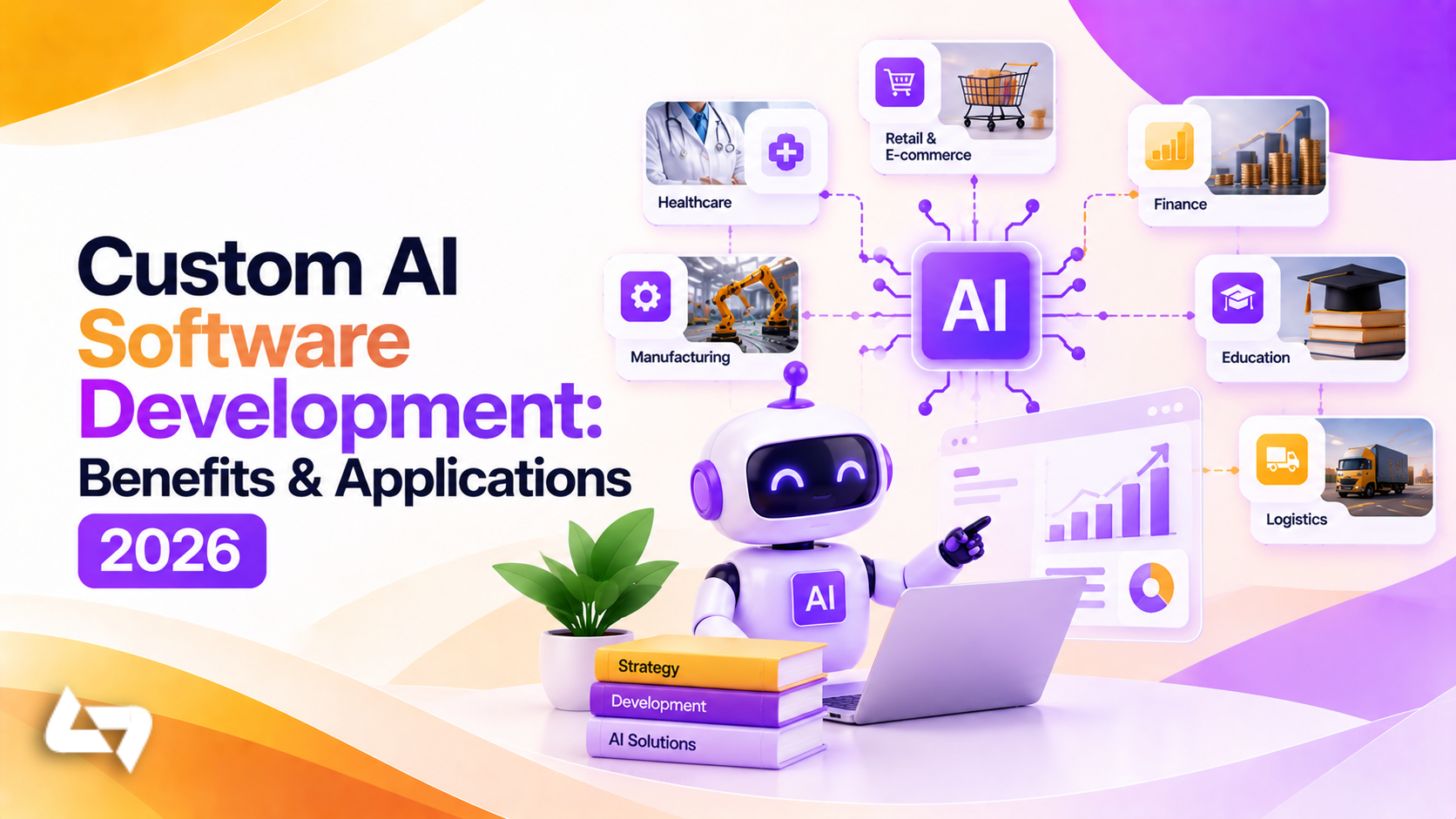
AI technology is transforming nearly every industry. Organizations are implementing intelligent systems to enhance decision-making, automate repetitive tasks, and improve customer interactions.
Healthcare
Healthcare providers use AI-powered applications for:
- Medical image analysis
- Predictive diagnostics
- Patient engagement systems
- Treatment recommendations
Financial Services
Financial institutions leverage AI for:
- Fraud detection
- Risk assessment
- Automated customer support
- Investment analysis
Retail and E-commerce
Retail businesses implement AI to improve:
- Product recommendations
- Inventory forecasting
- Customer behavior analysis
- Personalized marketing campaigns
Manufacturing
Manufacturers use AI-driven systems for predictive maintenance, quality control, production optimization, and supply chain management.
How AI Development Helps Business Growth
Today’s organizations need technology that keeps changing, not just sits there while business demands shift. Professional software development services let companies build AI solutions that boost productivity, lower day-to-day operating costs, and make customers feel more supported. And yes, the “how” matters—because the implementation tends to decide whether the improvement is real or only a promise
Also, when a company invests in advanced software development solutions, it gets more freedom. That means they can grow features faster, merge in new tech as it appears and usually, respond more quickly to market changes, even when things feel a bit messy.
Long-Term Advantages
Businesses that implement custom AI platforms often experience:
- Faster decision-making
- Reduced manual workload
- Higher customer retention
- Better operational visibility
- Increased revenue opportunities
Choosing the Right Development Partner
Selecting the right tech partner is kind a critical if the AI project is going to work. Businesses should look closely at technical competence, how much experience they have in your industry, which development approach they use, and what kind of post-launch support they provide later on.
A dependable provider for custom application development services can guide organizations through complicated AI initiatives. In the same time, they can still keep the work scalable, make security less “maybe”, and protect the long-term value of what gets built.
Conclusion
Custom AI software development is turning into more of a strategic investment for businesses that want better efficiency, smoother automation of operations, and a competitive edge in 2026. When organizations build tailored AI apps that match specific business goals, they often unlock fresh opportunities for innovation and growth that stays steady.
Whether it’s improving customer interactions, streamlining internal processes, or supporting smarter decisions with data, custom AI solutions can be a strong route toward digital transformation. Basically, it helps the business become more future-ready… even when the future is arriving sooner than expected.